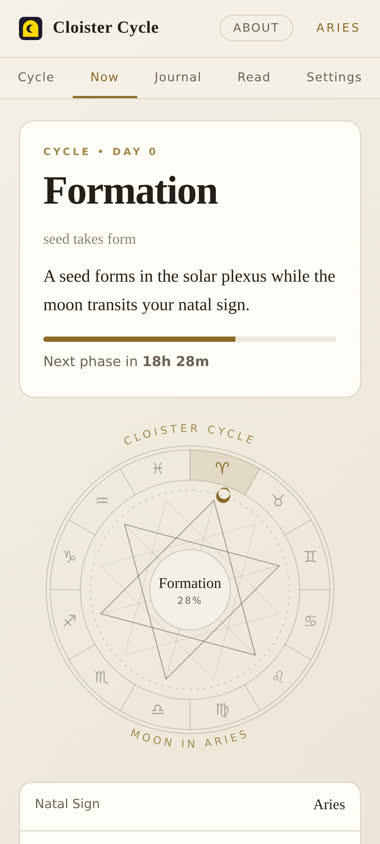
Cloister Cycle is a lunar calendar and private practice journal built from George W. Carey’s 1917–1920 writings. Every doctrinal statement it shows you carries the book and page it came from, so you can check it against the scan. Nothing is scored or prescribed, and nothing leaves your device.
The moon’s transit of your natal sign is found from the ephemeris and the exact crossing is bisected to the minute. The familiar figure near 27.3 days comes out of that calculation. Nothing in the app assumes a cycle length.
Note what you observed, day by day. Five observances are offered because Carey names those five, each with the page that reveals why. There is no streak or score, and no screen telling you that you failed.
Three volumes ship whole and page-numbered. When the app quotes Carey you can open the passage around the quote and read what he actually wrote on either side of it.
Keep a chart for yourself and for anyone else you follow. Each carries its own journal and reading progress; removing one removes its entries with it.
The same material in the register you think in: Carey’s own scriptural terms, a plain physiological wording, or a neutral one. It changes the words and keeps the citation.
It gives no dose, supplier, diet or instruction. It does not tell you the doctrine is true. Carey rejected dieting and fasting by name, and an app that quietly added them back would be misrepresenting him.
Across his own books he gives three incompatible figures for the length of the cycle: 29½ days in 1917 and again in 1920, 28½ days stated four times in 1918 (once spelled out in words on page 109), and elsewhere the transit of a sign, which is closer to 27.3. He never reconciles them.
Cloister Cycle does not quietly pick the flattering one. It computes the transit, labels that figure as computed, and records the disagreement where you can see it. The same applies to the points where his own text is ambiguous: those are marked as an interpretation split rather than resolved on your behalf.
Only volumes whose scans carry usable page markers are shipped. Carey wrote more than these, but the app exists so that every passage can be looked up, so the rest stay out until a citable scan exists.
Pages 9 to 175, 1,322 paragraphs. The fullest statement of the doctrine, and the source of most of what the calendar cites.
Pages 13 to 125, 899 paragraphs. Where the 28½-day figure is stated, four times.
Pages 7 to 60, 368 paragraphs. The earliest of the three, and the source of the sign-by-sign material.
All three are in the public domain and were published between 1917 and 1920. Cloister Cycle presents Carey’s claims as Carey’s, in a standing attribution banner on every doctrinal view.
Your birth date, your journal and your reading position live in your browser’s storage on your own device. Reading, journalling and viewing the cycle work with no network at all, because the books and the astronomy are both on board. There is no analytics, no account and no sync. You can export everything as a file, restore it on another device, and erase it in one tap.
The honest caveat: browser storage is not permanent by default. Some browsers clear it when they close or when space runs low. The app asks yours not to, tells you in Settings whether it agreed, and gives you the export file, the one copy no browser setting can remove.
A doctrine set out by George W. Carey between 1917 and 1920, which reads the biblical narrative as an account of a monthly process in the body rather than as history. Cloister Cycle presents it as Carey’s position, with the page it came from. It does not assert that he was right.
Carey gives three answers and never reconciles them: 29½ days, 28½ days, and the moon’s transit of a sign. The app computes the transit of your own natal sign from the ephemeris, which lands near 27.3 days, and shows you the disagreement rather than hiding it.
$19.99, paid once, for every way of running it: Google Play, the direct APK, and the web app. There is no subscription and nothing further to buy inside it. No account and no newsletter.
Yes. Both source texts and astronomy are computed on the device. Once loaded it works in airplane mode.
Web: Open the app, then use your browser’s Add to Home Screen or Install option. It then behaves like an installed app, works offline, and browsers treat an installed app’s stored data as worth keeping, so your journal is much less likely to be cleared. Android: Install from Google Play, or download the APK directly. Buying through Play unlocks it there; buying direct sends you a key that unlocks the APK and the web app.
No. It is not connected to any church, organisation or teacher, and it is not a devotional app. It is a reading and record-keeping tool for a specific body of century-old writing.